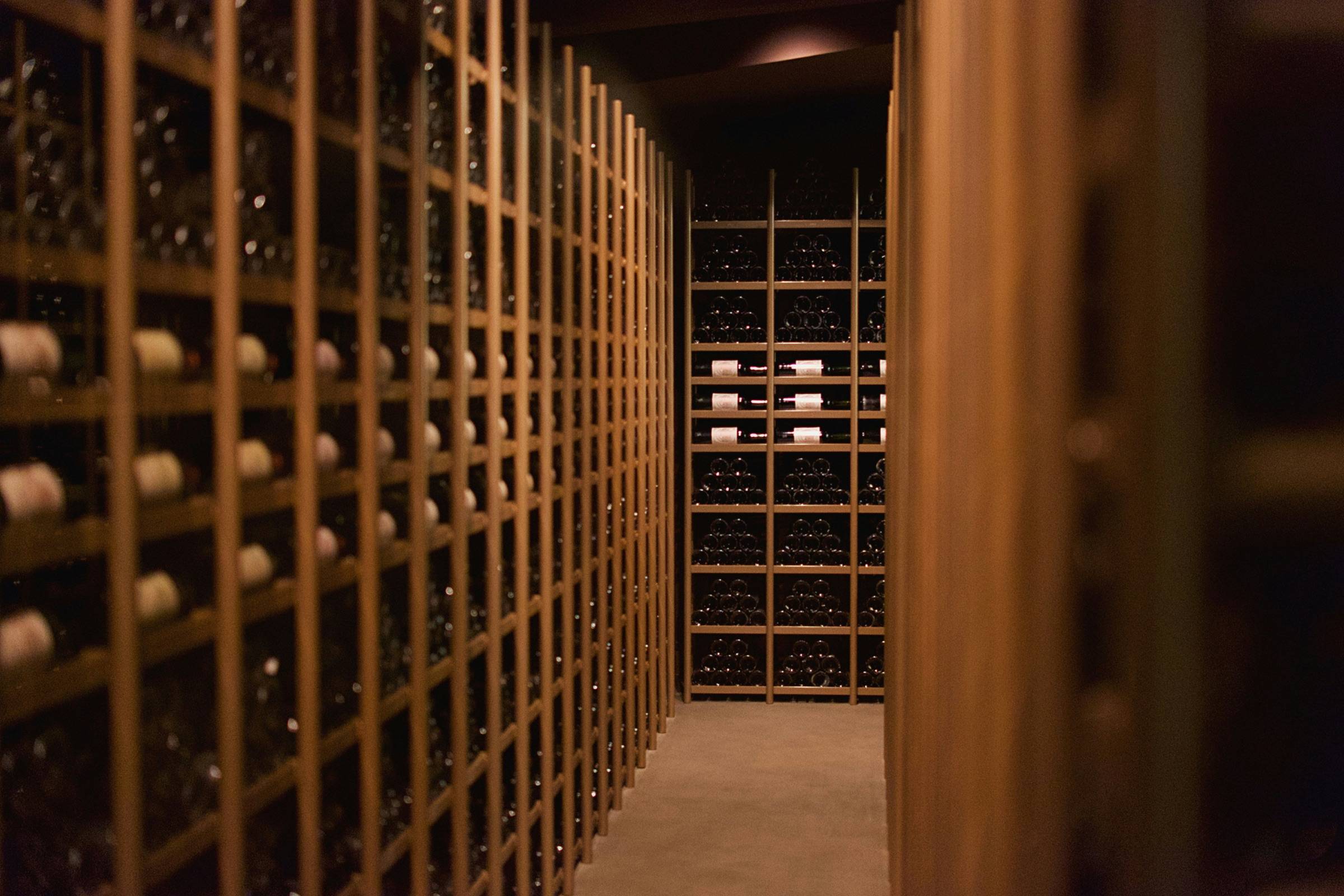
Product-only versus installed
Most published rack prices are product only. They exclude freight, sales tax, installation, blocking, lighting, and anything to do with the room. An installed price adds layout, anchoring, leveling, assembly, and the installer’s travel and minimum charge. When comparing a retailer listing with an installer’s proposal, convert both to the same scope first.
Some published figures do not state scope at all. A racking retailer’s price guide describes storage for a 500-bottle collection at about $15,000–$22,000 without saying whether installation is included (Wine Racks America price guide). Treat figures like that as examples to ask about, not as a benchmark.
Price per bottle as a rough comparison
Dividing a rack price by its rated bottle positions gives a quick way to compare options of similar type. Two published anchors illustrate the spread:
Simple unfinished modular wood racking
Approximately About $4–$6 per bottle
Unfinished self-assembly wood kits are published at a few dollars per bottle position. Finished and premium kits cost more.
Published examples: Wine Racks America
Wall-mounted metal rack components
Approximately Tens of dollars per peg to four-figure kits
Published metal components range from individual display pegs to multi-rack wall and under-stair kits.
Published examples: VintageView
These are manufacturer- and builder-published planning examples, not independent national averages or project quotes. Scope definitions vary.
On the metal side, a published four-foot wall-mounted metal rack (12, 24, or 36 bottles at single, double, or triple depth) is listed at about $150–$250 per rack(VintageView catalog). Because the same run holds more bottles at greater depth, its per-bottle price falls as depth increases. Individual display pegs, by contrast, are priced per bottle and cost far more per position. Packaged wood cellar kits are listed at about $3,000–$27,500 depending on bottle count (Wine Racks America kits).
Why price per bottle can be misleading
- Different storage styles. A label-forward display position and a bulk-bin position are not the same product. Per-bottle figures reward density and penalize display.
- Rated versus practical capacity. Rated capacity assumes standard 750 ml bottles. Wider bottles, magnums, and specialty shapes reduce practical capacity.
- Scope differences. One price may include frames, connectors, and trim; another may list them as accessories.
- Finish and species. The same layout in unfinished pine and in a premium stained hardwood can differ several times over.
- Room costs do not scale with racks. The cheapest per-bottle rack can still sit in an expensive room. Glass, cooling, and construction usually outweigh racking differences.
Use per-bottle figures to compare like with like, then look at the whole room. Thewine room cost guide explains the other layers.
System family comparison
Densities below are conceptual planning values in bottle positions per square foot of wall face, one bottle deep unless noted. They are derived from typical bottle geometry and published product capacities, not manufacturer layout rules.
| System family | Visual character | Density | Product-price behavior | Installation complexity | Best planning use | Principal caveat |
|---|---|---|---|---|---|---|
| Wall-mounted metal | Minimal, floating rows; bottles appear to hover | Cork-forward about 7–9.5 per sq ft single-deep; label-forward about 2.5–4 | Low per rack run; rises with depth, finish, and display pieces | Moderate; depends on wall framing and level layout | Wine walls and modern rooms | Needs solid backing; capacity depends on spacing chosen in layout |
| Floor-to-ceiling metal frames | Architectural grid from floor to ceiling | Similar to wall-mounted metal per sq ft; about 7–9.5 cork-forward | Higher than wall racks; adds posts, panels, and connectors | Moderate to high; anchoring top and bottom | Full-height feature walls and glass rooms | Ceiling height and floor levelness affect fit and cost |
| Peg and rail | Individual bottles displayed on pegs or rails | Mostly label-forward or vertical; about 2.5–4 per sq ft | Priced per peg or rail; expensive per bottle at scale | Moderate; many individual anchor points | Accent displays and featured bottles | Low density; best combined with denser storage |
| Acrylic | Transparent, gallery-like display | Display-oriented; often about 2.5–4 per sq ft or less | High per bottle relative to metal or wood | Moderate; follow manufacturer mounting | Contemporary display walls | Display focus; finish and scratch care |
| Modular wood | Traditional cellar look in kit form | Individual cubbies about 7–9 per sq ft; bins higher | Lowest published per-bottle prices when unfinished | Low to moderate; assembly time is significant | Storage-focused rooms and owner installation | Module sizes may not fill walls exactly |
| Custom wood | Fitted, furniture-grade millwork | Varies with design; can mix cubbies, bins, and display | Highest per bottle; set by species, finish, and detailing | High; built or fitted on site | Rooms with irregular walls or integrated cabinetry | Lead time and per-project pricing |
| Bins and lockers | Diamond or rectangular bins; lockable compartments | Bins about 11–17 per sq ft; lockers about 5–9 | Bins low per bottle; lockers higher with doors and locks | Low to moderate | Bulk storage and shared or secured storage | Slower access to individual bottles |
Wall-mounted metal
Wall-mounted metal racks are rows of rods or cradles fixed directly to the wall, typically holding bottles cork-forward one, two, or three deep, with label-forward display pieces mixed in. They suit wine walls and modern rooms and are among the easiest systems to price from published catalogs (VintageView catalog). Capacity is set during layout by rack length, number of rows, depth, and spacing (VintageView layout guide). The product is often inexpensive relative to the wall preparation and lighting around it.
Floor-to-ceiling metal
Frame systems carry metal racks on posts or panels from floor to ceiling, creating an architectural grid that can stand off the wall or fill a glass room. Frames add product cost and installation time, and ceiling height and floor level matter. Manufacturers offer a range of wall, frame, and display families (Wine Rack Concepts metal families).
Peg and rail systems
Pegs and rails hold individual bottles, usually label-forward or upright. They make striking accent walls but are among the most expensive options per bottle because each position is its own part and anchor point. Published display pegs are listed in the low tens of dollars each (VintageView catalog), and anunder-stair metal display kit (about 45 bottles) is listed at about $1,200–$1,400.
Acrylic
Acrylic systems give a transparent, gallery-like display. They are display-oriented and lower in density, so cost per bottle tends to be higher than metal or wood. Care for the surface, mounting details, and how the material looks under integrated lighting are worth asking about.
Modular wood
Modular wood racking comes in standard-width modules: individual bottle columns, diamond bins, case cubbies, display rows, and corner units (Wine Rack Concepts modular wood series). Unfinished self-assembly kits carry the lowest published per-bottle prices, at about $4–$6 per bottle(Wine Racks America price guide). Stained or finished kits, hardwood species, and trim cost more. Modules may not fill a wall exactly, so fillers and trim are part of the layout.
Custom wood
Custom wood racking is designed and built for a specific room: curved corners, arches, integrated cabinetry, tasting counters, and display features. It handles irregular walls well and offers the most design control, at the highest cost per bottle. Pricing is per project and depends on species, finish, detailing, and the fabricator.
Bins and lockers
Diamond and rectangular bins hold several bottles in each opening, giving the highest face density at a low cost per bottle, with slower access to any single bottle. Lockers add doors and locks for shared or secured storage, which reduces density and raises cost.
Case storage
Open case shelves and case cubbies hold wine in its shipping case. They are simple and inexpensive per bottle and useful for wine that arrives by the case and will be moved into racking later, or for collectors who keep cases intact.
Display rows
Angled presentation rows show one bottle’s label per position at a slight tilt. They make a room feel curated but give up density: conceptual planning values are about 1.5–3 positions per square foot of wall, well below cork-forward storage. A single band of display rows at eye level often delivers most of the visual effect.
Large-format storage
Magnums and larger bottles need larger openings, shelves, or cradles. Standard openings rarely accept them, and Burgundy and Champagne bottles do not fit every standard opening either. If a collection includes large formats, plan dedicated positions for them; they cost more per bottle and reduce the count a wall can hold. Thecapacity guide explains how bottle mix changes capacity.
Finish
Finish affects price within the same product line. Matte black metal is often the baseline; brushed, bronze, and custom finishes cost more. In wood, unfinished softwood is the baseline and stained, lacquered, or premium hardwood finishes add cost and lead time. Finish choices should coordinate with lighting, glass hardware, and the room’s other metals and woods.
Depth
Storing bottles two or three deep increases capacity on the same wall without a matching increase in product or labor, so cost per bottle usually falls as depth rises. The trade-off is access: bottles behind the front row are harder to see and retrieve. Deeper racks also project further from the wall, which affects circulation in narrow rooms.
Mounting and substrate
Wall-mounted systems depend on the wall behind them. Light displays may anchor into studs; tall or heavily loaded systems may need continuous blocking or a backer installed before finishes. Masonry and stone walls require different anchoring. If framing is unknown in a finished wall, opening it for backing becomes a construction cost. Freestanding wood racks still need to be secured against tipping. Follow the manufacturer’s mounting instructions and have a contractor confirm the wall.
Freight and installation
Small metal racks may ship by parcel; frames, wood kits, and large orders usually ship by freight, sometimes with a liftgate charge. Packaged kits often list shipping separately. Installation ranges from an afternoon of owner work for a few wall racks to several days of professional assembly and fitting for a full room. Professional installers commonly have a minimum charge even for small jobs.
Even with freight and installation, racking is usually the smaller part of a conditioned room. A passive display assembled from published products may sit in the $1,000–$10,000+ band; a climate-controlled room around the same racks is a different budget entirely.
Choosing a system for your budget
There is no single best racking system. The right choice depends on how the collection is used, how it should look, and what kind of room it lives in. A few patterns help narrow the field.
- Storage-first collections tend to get the most positions per dollar from modular wood cubbies and bins, or double- and triple-deep metal, with a small display area for featured bottles.
- Display-first walls lean on wall-mounted metal, pegs, or acrylic, where the visual effect justifies a higher cost per bottle. Mixing in denser storage above and below eye level keeps the total in check.
- Irregular rooms, such as under-stair spaces, sloped ceilings, and odd corners, often favor metal systems that cut to length, or custom wood that is fitted on site, over standard modules.
- Rooms with integrated cabinetry usually point toward custom wood, or a combination of metal racking with separately built millwork.
- Mixed bottle collections benefit from planning large-format and wide-bottle positions explicitly rather than assuming every opening is standard.
Whichever family you choose, ask the manufacturer or retailer for a layout on your measured walls before you finalize a budget. That layout gives the product-rated capacity and the parts list, which is the only reliable basis for a racking price.
Methodology
Product prices on this page are published examples from the manufacturers and retailers cited, paraphrased with the scope each states, and they change over time. Densities in the comparison table come from the planner’s conceptual capacity profiles, derived from typical bottle geometry and cross-checked against published product capacities; they never produce an exact bottle count. Only a manufacturer layout with a specific product family gives a rated capacity. Pricing was last reviewed in October 2026; see thewine room cost guide methodology for how planning bands are built.
Sources
- VintageView metal wine rack catalog
- VintageView’s guide to laying out a metal wine wall
- VintageView’s wine-cellar budgeting and value guide
- Wine Racks America’s wood wine rack price guide
- Wine Racks America’s wood wine-cellar kits
- Wine Rack Concepts’ metal wine rack families
- Wine Rack Concepts’ modular wood rack series
See all sources, with links and verification dates.
Independence and limits. Design My Wine Room is an independent planning resource, not a manufacturer, contractor, glazier, or cooling designer. Estimates, capacity ranges, and cooling guidance are preliminary planning information—not quotes, guarantees, or engineering. Final decisions must be confirmed by qualified local professionals and the applicable manufacturers.