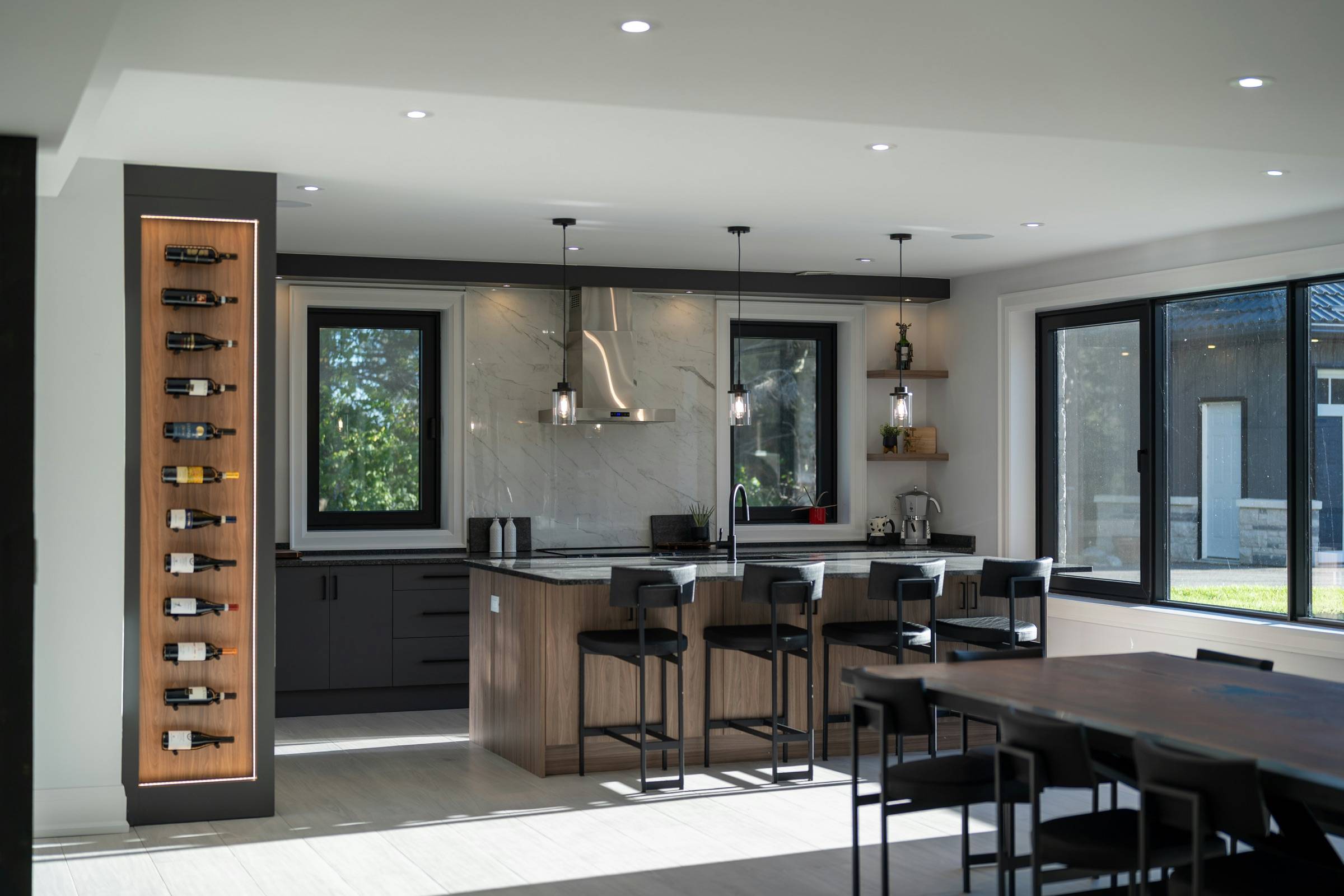
What “wine wall” can mean
The phrase is used for very different projects. It can describe a few dozen bottles on wall-mounted metal racks in a dining room; a full-height architectural display that anchors a living space; a glass-fronted enclosure set into a wall; or a conditioned storage environment that happens to be shallow. When someone quotes a price for “a wine wall,” the first question is which of these they mean.
The distinction matters for conditions as well as cost. An open display wall shares the temperature and humidity of the room it sits in. It can be a fine way to display and organize bottles that will be enjoyed in the near term, but it does not maintain controlled storage conditions. Only an enclosed, actively conditioned wall is designed for that, and even then performance depends on the enclosure, glass, surrounding conditions, and cooling design.
Types of wine walls
| Type | What it is | Typical cost layers | Storage conditions |
|---|---|---|---|
| Open passive display wall | Racks or pegs mounted on a finished wall, no enclosure | Racking, anchoring, optional lighting | Follows the room; display, not controlled storage |
| Wall-mounted racking | Rows of metal or wood racks fixed to the wall at chosen heights | Racking, blocking if needed, installation | Follows the room |
| Floor-to-ceiling display frame | Posts or panels carrying racks from floor to ceiling | Frames, racks, connectors, anchoring, lighting | Follows the room unless enclosed |
| Enclosed glass wine wall | A shallow display behind a glass front and door | Racking, glass, door, seals, framing, finishes | Separated from the room; not conditioned on its own |
| Actively conditioned wine wall | An enclosed wall with dedicated cooling | All of the above plus envelope, cooling equipment and installation, electrical | Conditioned, subject to design and heat-load calculation |
| Cabinetry-integrated display | Racking set into millwork, often with counters and storage | Cabinetry, racking inserts, lighting, finishes | Usually follows the room |
| Under-stair wall | Racking shaped to the stair profile | Shaped racking, anchoring, lighting, often glass | Follows the room unless enclosed and conditioned |
Simple rack-only wall
The least expensive wine wall is a set of wall-mounted racks or pegs on an existing finished wall, installed by the owner. One manufacturer’s budgeting guide describes a simple self-installed passive wall at about $1,000–$2,000(VintageView budgeting guide). Published product listings show why: a four-foot wall-mounted metal rack (12, 24, or 36 bottles at single, double, or triple depth) is listed at about $150–$250 per rack, product only (VintageView catalog).
Even at this level, the total is more than the rack price. Anchors, a stud finder or blocking, a level, possibly a few display pegs, lighting, freight, and tax all add up. Rack-only walls are also where self-installation is most practical, provided the wall framing can carry the load.
Professionally installed display wall
A larger or more architectural wall usually involves a layout service, professional installation, integrated lighting, and often a back panel or finish carpentry that frames the display. Floor-to-ceiling frame systems add posts, panels, and connectors. This is where published planning examples move into the $15,000–$40,000+ band. The increase is mostly labor, lighting, and finish work rather than racking.
Enclosed glass wall
Enclosing a wine wall behind glass separates the display from the room, protects it from dust and handling, and creates the option of conditioning it later. Published glass enclosure and wine-wall enclosure packages run about$20,000–$30,000+ before room construction, cooling, installation, tax, and freight (Vineyard Wine Cellars listings). Custom glass can differ materially from packaged systems.
An enclosed wall that is not cooled still follows the surrounding room over time; the glass alone does not create a storage environment. If cooling is a possibility, plan the enclosure, door seals, and equipment location for it from the start.
Actively cooled wall
A conditioned wine wall is effectively a shallow wine room. It needs a sealed enclosure, an insulated back and sides where possible, a door that closes reliably, cooling equipment, and somewhere to reject heat and drain condensate. Because the glass front is large relative to the enclosed volume, glass usually dominates the heat load (WhisperKOOL on glass cellars). A final heat-load calculation and professional glass and cooling review are required.
Because glass, door, and cooling costs do not shrink in proportion to the wall’s size, a cooled wine wall can cost as much as, or more than, a small walk-in room. See the wine room cost guide for the full room picture and the cooling cost guide for equipment categories.
Bottle-capacity effects
Capacity drives racking cost, but less directly than people expect. Adding a second or third bottle of depth to a wall-mounted metal rack can increase capacity without a matching increase in wall area or installation labor. Adding height usually means a frame system, a ladder-reachable top row, and more lighting. Adding width means more wall to prepare.
Treat any capacity number as conceptual until a manufacturer lays out a specific product family on your measured wall. Bottle shape matters: Burgundy and Champagne bottles, magnums, and specialty shapes do not fit every standard opening. Thecapacity guide explains reserve capacity and bottle mix, and one manufacturer’s guide shows how rack length, rows, depth, and spacing set capacity during layout (VintageView layout guide).
Label-forward versus high-density storage
Label-forward display shows each bottle side-on, which is visually striking but uses far more wall per bottle. Cork- or neck-forward storage packs bottles end-out at much higher density. A wall built mostly for display therefore costs more per bottle than one built mostly for storage, even with the same product line. Many walls combine a band of label-forward rows at eye level with denser storage above and below; that balance is one of the most useful levers in the budget.
Wall substrate and blocking
Wall-mounted racks rely on what is behind the drywall. Studs at regular spacing may be enough for light displays; tall, deep, or heavily loaded racks may need continuous blocking or a backer. If the wall is already finished and the framing is unknown, opening it to add backing, then patching and refinishing, is a real cost. Masonry, tile, and stone walls need different anchoring and more installation time. Manufacturer mounting instructions govern; a contractor should confirm the wall can carry the load.
Lighting
Lighting changes how a wine wall reads more than almost any other element. Options range from ceiling fixtures washing the wall to LED strips integrated into each display row. Integrated lighting adds fixtures, drivers, wiring paths, switching or dimming controls, and an electrician. Plan driver locations and wire routes before panels and racks go up. In an enclosed or cooled wall, choose low-heat lighting, since fixtures add to the heat load.
Back panels
A back panel behind the racks in wood, stone, metal, or a painted finish gives the wall depth and hides anchoring and wiring. Costs depend on material and size. Panels also affect installation: racks may anchor through the panel into blocking, which needs to be planned before either goes up.
Millwork
Cabinetry-integrated walls combine racking with base cabinets, counters, open shelving, or a surround. Millwork is priced per project by local fabricators and can quickly exceed the racking budget, particularly with stone counters or premium species. If cabinetry is inside an enclosed or conditioned wall, check that materials and finishes suit those conditions.
Glass and door
An enclosed wall usually needs at least one door for access. Some premium packaged glass doors are listed atabout $10,000–$12,000 (Vineyard Wine Cellars listings), and simpler insulated glass doors cost less. Hinges or pivots, seals, closers, and handles may be separate. Glass panel layout, framing choice, and hardware are decisions for the glass supplier and a qualified professional. Theglass wine room cost guide covers those choices in more depth.
Cooling
Published cooling equipment examples span roughly $3,000–$16,000+ before installation (Wine Rack Concepts cooling catalog). Compact through-wall and self-contained units sit toward the lower end, but a wine wall may not have a practical place for a through-wall unit to exhaust heat. Split or ducted equipment adds line sets or ducts, condensate handling, electrical work, and HVAC-R labor. Equipment must be selected from a final heat-load calculation, not from the wall’s size.
Freight and installation
Racks ship by parcel or freight depending on size; tall frames, glass, and cooling equipment usually ship by freight with a liftgate. Ask whether delivery is curbside or inside the home, and who unloads and stores the materials. Installation may involve a racking installer, a glazier, an electrician, an HVAC-R technician, and a carpenter, each with their own proposal. For an open wall, the owner or a single carpenter may handle everything.
Pricing examples
The following are individual published examples, product only unless noted. They show scale, not a complete project price.
| Example | Published price | Scope |
|---|---|---|
| Self-installed passive wine wall (one manufacturer’s example) | About $1,000–$2,000 | Published example; product-focused, self-installed |
| Four-foot wall-mounted metal rack (12, 24, or 36 bottles at single, double, or triple depth) | About $150–$250 per rack | Product only; excludes freight, tax, and installation |
| Under-stair metal display kit (about 45 bottles) | About $1,200–$1,400 | Product only; excludes freight, tax, and installation |
| Wall-mounted metal rack components | Tens of dollars per peg to four-figure kits | Product only |
| Simple unfinished modular wood racking | About $4–$6 per bottle | Product only |
| Glass enclosure and wine-wall enclosure packages | $20,000–$30,000+ | Product price examples |
| Premium packaged glass doors | About $10,000–$12,000 | Product price examples |
| Compact through-wall and self-contained units (one equipment catalog) | About $2,100–$3,400 | Equipment list price only |
A wall assembled entirely from these products still needs anchoring, lighting, freight, tax, and usually installation. An enclosed and conditioned wall adds construction, envelope, electrical, and professional services as well.
Ways to manage the cost
Most wine-wall budgets can be shaped without giving up the look that matters most. The levers below tend to have the largest effect for the least compromise.
- Decide on conditions first. Whether the wall is open, enclosed, or conditioned sets most of the budget. If the collection is for near-term enjoyment, an open or enclosed passive wall avoids cooling, envelope, and much of the electrical cost.
- Concentrate display where it is seen. Reserve label-forward rows for eye level and the sightline from the main room, and use denser cork-forward storage above and below.
- Use depth before width. Double- or triple-deep racks add capacity on the same wall without adding wall preparation, lighting length, or installation area.
- Confirm the wall early. Knowing where framing is, or adding blocking while a wall is open, costs far less than opening a finished wall later.
- Choose packaged glass where it fits. If an enclosure is planned, compare packaged systems with custom glass; standard sizes can cost less and ship faster, though they may not fit every opening.
- Plan for later stages. A wall can be built passive with an enclosure-ready opening and a cooling path planned, then enclosed or conditioned later. Planning the path now avoids rework.
Finish level and lighting are also flexible. A matte black finish and ceiling washers cost less than bronze finishes and row-by-row LEDs, and can be upgraded selectively at the focal area.
Questions to ask
- Is this price for racking only, or racking with installation?
- How many bottle positions does the layout hold, and are they single-, double-, or triple-deep?
- Which bottle shapes fit the openings, and where do magnums go?
- Is the wall framing known, and is blocking included if it is needed?
- Are lighting fixtures, drivers, wiring, and controls included, and who installs each?
- Are back panels, trim, and finish carpentry included?
- For an enclosed wall: are glass, door, hardware, seals, and field measurement included?
- For a cooled wall: who performs the heat-load calculation, and who is responsible for condensation risk?
- Is freight included, and is delivery curbside, liftgate, or inside the home?
- Who warrants the racking, the glass, and the cooling equipment?
Methodology
Bands on this page are the site-wide planning bands described in the wine room cost guide methodology, synthesized from manufacturer-, retailer-, and builder-published examples. Individual examples are paraphrased from the cited pages with the scope each publisher stated. Prices change, and catalogs are not exhaustive; we do not reproduce full product catalogs. Pricing was last reviewed in October 2026.
Sources
- VintageView’s wine-cellar budgeting and value guide
- VintageView metal wine rack catalog
- VintageView’s guide to laying out a metal wine wall
- Wine Racks America’s wood wine rack price guide
- Vineyard Wine Cellars’ glass wine-room doors and enclosures
- Wine Rack Concepts’ wine-cellar cooling catalog
- Wine Rack Concepts’ metal wine rack families
- WhisperKOOL on the challenges of glass wine cellars
See all sources, with links and verification dates.
Independence and limits. Design My Wine Room is an independent planning resource, not a manufacturer, contractor, glazier, or cooling designer. Estimates, capacity ranges, and cooling guidance are preliminary planning information—not quotes, guarantees, or engineering. Final decisions must be confirmed by qualified local professionals and the applicable manufacturers.